Commercial Kitchen Hood & Exhaust Cleaning
Restaurant hood, duct and exhaust fan cleaning
Duct Kings cleans commercial kitchen exhaust systems across the New York Capital Region and Hudson Valley: hood canopy, filters, plenum, the full duct run, and the exhaust fan on the roof.
Grease doesn't stay in the hood. It travels up the duct, coats the fan housing on the roof, and collects in the horizontal runs where nobody can see it. That buildup is why a fire inspector will ask for your last cleaning record, and why your insurance carrier wants to see a service tag on the hood.
Every job ends with the record and the tag that New York fire code requires, so when the inspector walks in, the answer is already on the wall.
- MFS Trade School Certified Hood Cleaner and Inspector, trained to NFPA 96
- Licensed & Insured
- Free Quotes
Certificate No. MFS000922
How Often Do You Need It?
It depends on what you cook, not how big your kitchen is. New York sets it like this:
| Your cooking operation | How often |
|---|---|
| Solid fuel: wood-fired ovens, charcoal, smokers | Monthly |
| High volume: 24-hour kitchens, charbroiling, wok cooking | Every 3 months |
| Most kitchens | Every 6 months |
| Low volume: church halls, seasonal spots, senior centers | Every 12 months |
Those are inspection intervals. If there's grease, it gets cleaned, which in a working kitchen usually means both happen on the same visit. A church hall might pass without a full clean, and we'll tell you that rather than sell you one. Your fire inspector can also put you on a shorter cycle if they've seen buildup before.
Not sure which row you're in? Call and describe your line. It takes about a minute to sort out.
What the inspector asks for
Two things: a record naming who cleaned the system and when, and a dated tag on the hood with the servicing company's name and phone on it. A paid invoice is not a record, and a lot of operators find that out during the inspection.
We leave both on every job, and the old tag comes down.
What Gets Cleaned
A hood cleaning that stops at the filters is not a hood cleaning. Grease in the duct run and the fan is where the fire risk actually lives. On a full service, Duct Kings cleans:
-
Hood canopy and interior surfaces cleaned down to bare metal.
-
Grease filters removed and degreased. They have to be UL-listed and in place any time the line is running, so we flag any that are damaged, warped or missing.
-
The plenum behind the filters, where grease collects first.
-
Horizontal and vertical duct runs through existing access panels.
-
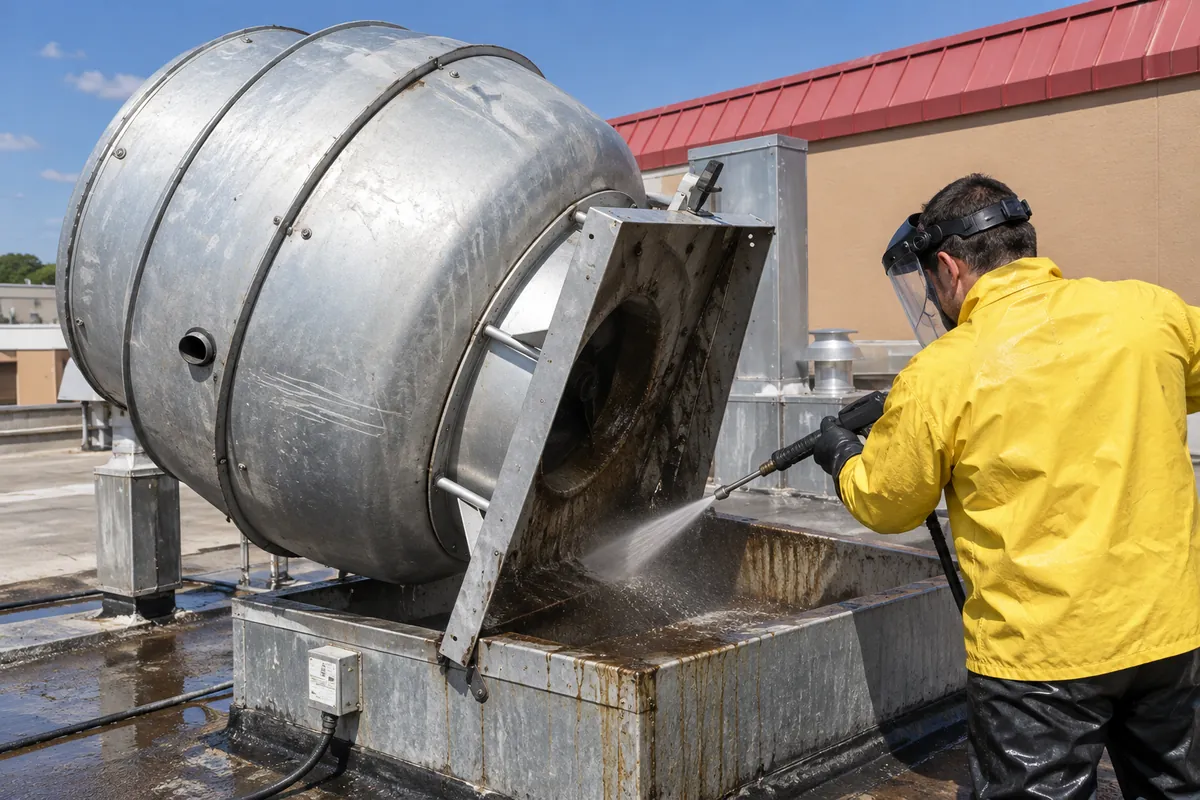
The exhaust fan blades, housing, and the fan curb on the roof.
-
Rooftop discharge area including grease containment if your system has it.
-
Wash-down and containment so the grease and cleaning solution leave with us instead of going down your floor drain or across your roof.
Where the Grease Actually Is
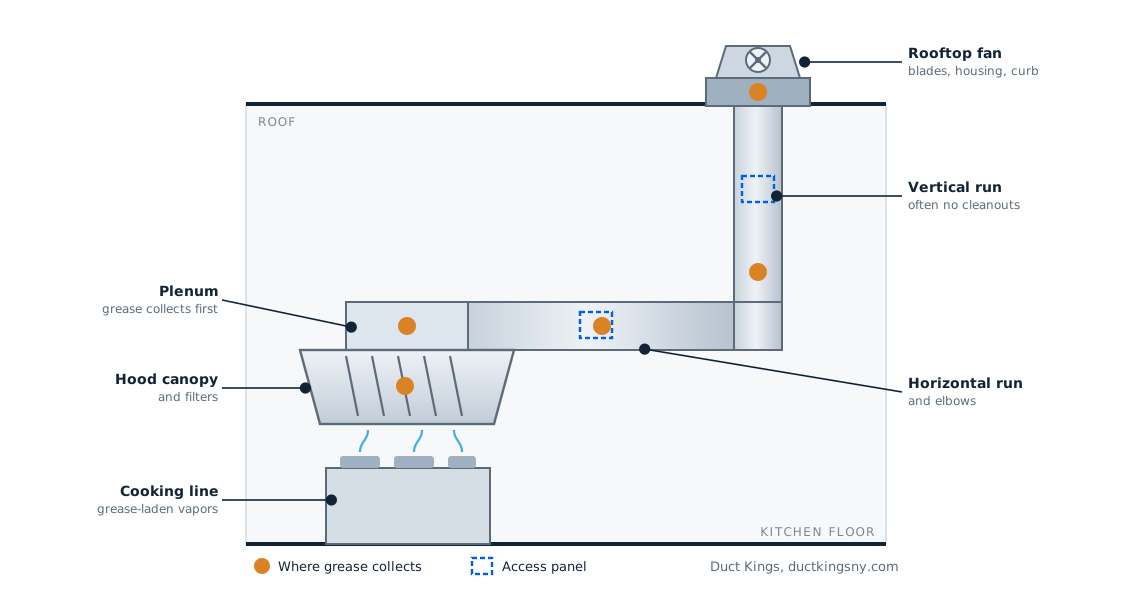
Most of a kitchen exhaust system is out of sight, either inside a duct chase or up on the roof. This is what we are cleaning, and where the grease collects.
Older Buildings and Access Panels
In older downtown buildings in Albany, Troy and Schenectady, the duct usually makes a long vertical run to the roof through a chase with no cleanouts. If your system doesn't have enough access panels to reach the whole run, we'll tell you where it needs them before we start, not after.
Signs Your Exhaust System Is Overdue
-
Grease dripping from the hood, filters or the duct seams
-
A visible grease pool on the roof around the fan curb
-
Smoke hanging in the kitchen instead of pulling up through the hood
-
A rancid or stale grease smell in the kitchen, the dining room, or near the roof vent
-
Filters that stay tacky within days of cleaning
-
Fan noise, vibration, or a belt that keeps slipping
-
No service tag on the hood, or a tag with a date you cannot remember
-
A fire inspector already asked you for a record you did not have
The fan one is worth spelling out, because it's the one operators treat as a maintenance problem rather than a grease problem. A rooftop fan that's noisy, shaking or throwing its belt is usually loaded with hardened grease, which throws the blade out of balance and wears the bearings. Cleaning it often fixes the noise. If it doesn't, the bearings or the belt are worn and that's a repair, which we'll tell you about rather than cleaning it and walking away.
Our Commercial Kitchen Exhaust Cleaning Process
- 1
Walk the system.
We look at the hood, the filters, the accessible duct, and the fan on the roof, and we tell you what condition it's actually in before quoting.
- 2
Set the schedule.
We match your interval to what you cook. Solid fuel is monthly, charbroiling and 24-hour kitchens are quarterly, most kitchens are twice a year.
- 3
Protect the kitchen.
Equipment, floors and wall surfaces get covered, and we contain the wash-down so nothing ends up in your floor drains.
- 4
Clean to bare metal.
Hot water and degreaser through the hood, plenum, accessible duct and fan, to the ANSI/IKECA C10 standard New York points to.
- 5
Clean the roof side.
Fan blades, housing and curb, with grease containment checked and serviced.
- 6
Document and tag.
You get a written service record, and a new tag goes on the hood with our name, address, phone and the date. The old tag comes down.
- 7
Remind you.
We schedule the next service before we leave so the interval doesn't slip.
What We Do Not Do
Your hood almost certainly has a wet chemical fire suppression system over the cooking line. That system is on its own service schedule under the same fire code, and it's a different trade. Duct Kings doesn't inspect, service or recharge suppression systems. If yours is due, your fire protection contractor handles it, and we'll coordinate scheduling so the two don't collide.
We also don't do grease trap pumping or hood installation.
Kitchens We Work With
-
Restaurants, bars and breweries
-
Pizzerias with wood-fired ovens, which fall under the one-month interval
-
Hotel and banquet kitchens
-
School, college and senior living dining halls
-
Church halls, fire company halls and senior centers, which the code names specifically as low-volume operations
-
Seasonal kitchens, including the Saratoga Springs restaurants that run at full volume through track season
Seasonal volume matters more than most operators expect. A kitchen that charbroils through July and August is running at a high-volume interval during the season even if it sits at low volume the rest of the year.
Opening a new place, or taking over an existing one? Get the system cleaned and tagged before you open rather than after your first inspection. On a takeover you're inheriting whatever the last operator left in the duct, and there's usually no record of when it was last done.
What Affects the Price
We quote per system after looking at it. The things that move the number:
-
Number of hoods and fans, and whether they share a duct run
-
Length and routing of the duct, and how much vertical run there is
-
How many access panels exist, and whether the run can be reached at all
-
Roof access, height, and whether the fan is hinged
-
How long it has been since the last cleaning. First cleans on a neglected system take longer
-
Your required interval, since ongoing scheduled service prices differently than a one-off
Call for a free quote. We'll look at the system and give you a number before any work starts.
Areas We Serve
Out of Mechanicville, we cover Saratoga Springs, Albany, Troy, Schenectady, Clifton Park, Latham, Glens Falls, Ballston Spa, Malta and the surrounding Capital Region.
Out of Poughkeepsie, we cover Poughkeepsie, Fishkill, Wappingers Falls, Beacon, Hyde Park, Rhinebeck, LaGrange and the surrounding Hudson Valley.
Capital Region: (518) 718-3828
Hudson Valley: (845) 622-6371
Contact Duct Kings For Commercial Kitchen Hood Cleaning
Free quotes. We'll tell you what your interval should be and what it takes to get the system compliant.
Request A Free Quote